 |
| How do I not remember the Sales Bug of the Year? |
Showing posts with label Technical Readout. Show all posts
Showing posts with label Technical Readout. Show all posts
Saturday, October 29, 2016
Grange Class YardShip
[This has been sitting on my desktop for ages. Haven't got around to full stats yet.]


Saturday, September 17, 2016
Have a 'Mech, Frankie Valli

I was pretty proud of that "Meacham / each won" rhyme.
The tune is a brassy, energetic variation on Mack The Knife. The CD jacket claims it's performed by Frankie Valli and The Four Seasons, but it's a cheap CD compilation, and I don't really trust their fact checking.
The full lyrics are unGoogleable, so I've put them [with some guesses] below the cut.
Monday, September 5, 2016
Have a 'Mech: Hornet LAM


Text version here. I still dislike how google is handling image hosting.
I'm pretty happy that I managed to keep it under 1000 words. It no doubt helps that my sources gave me very little text to rehash. Which isn't to say I wrote it wholecloth; like my first two LAMs, I pieced it together from a hundred little notes. That resulted in a bunch of "point, counterpoint" phrasings that I'm not really happy with, and probably contributed to how long it took to finish.
I didn't set out to make three Davion LAMs. But in hindsight, the Davion-centrism and Macross-centrism of the early material did make it kind of likely. I think I'll eventually follow up with a Jade Falcon LAM, a revision of my WoB Tarantula LAM, and a Rasalhague VTOL (an LAM hunter). That would give the series one unit per era, which would be kind of neat.
Images are all related to the writeup. The oldest rendition of a Hornet is seen at left; bottom compares a modern Hornet with the similar Duan Gung; and bottom right is the earliest rendition of a Chameleon trainer 'Mech, showing clear influences from the "I turn into a fighter plane" corps of 'Mechs.


Tuesday, May 3, 2016
New Fan TRO: Built For War
Some guys are putting together a new Fan TRO called Built for War, and they recently posted a teaser preview! The fluff text isn't displaying correctly for some people, but whatever. It's a teaser. You can still see their layout and the Plog and Scroggins art.
I like what I've read so far. I like how the layout looks too, though maybe something more compact would've suited the omni units better.
I like what I've read so far. I like how the layout looks too, though maybe something more compact would've suited the omni units better.
Tuesday, April 5, 2016
Have a Mech: Eridani LAM

(Text version here.)
Where my Banshee LAM entry was all about how awesome the Banshee is, this Merlin entry is more about the circumstances surrounding the Merlin.
It's longer than I'd like. Were I trying to fit it onto an actual published page, I'd probably have to trim some of the setup from the historical battles, and abbreviate the description of the -2X variant.
Edit, April 6: Someone pointed out that the Merlin was the construction example in BattleDroids too, not just 2nd Edition BattleTech. Half-ton jump jets and everything! Still a good fit for the Super Griffin, though. /Edit
Sunday, January 11, 2015
Have a 'Mech: 1st Somerset Strikers LAM
On New Year's I saw that I have an awful lot of BattleTech notes sitting idle on my computer, and so I've decided to clean them out, fill them out, and post them. First up is an LAM.

It's 50 tons, moves 4/6/4 on the ground, 5/8 in space, has two ERLLs, a C3 Master, and fuel is a bit on the low side.
At 1136 words the fluff is right at the limit for TR:3025. I could probably shave a line or two off to fit. Were I writing it for a shorter, 550-750 word entry, I'd probably design a second LAM and split half the fluff out to the new design.
Sorry about the small font in this image, you can find the original HTML here. (When I was replying to comments there, I saw that the smaller font on the "reply to post" screen made my two columns line up miraculously well. I just had to take a screenshot.)
Sunday, September 7, 2014
Summertime Space Travel
Earlier this year I figured out the rules ye olde DropShips and JumpShips used to construct JumpShips. It's pretty similar to what Chris Hartford(?) devised for BattleSpace.
The common assumption is that Chris couldn't find any rhyme or reason to the earlier stats. But JumpShips were pretty easy to figure out, so I think it's equally likely that he found the system and decided to change it.
DropShips are harder. (One confounding factor is that transit thrust seems to be independent of combat thrust.) I took a break from working them out to do some astrography; unfortunately, that was interrupted, and all such endeavors remain disrupted for me through the present. I hope to resume normal activity in a few weeks.
Notes about DS&JS:
The common assumption is that Chris couldn't find any rhyme or reason to the earlier stats. But JumpShips were pretty easy to figure out, so I think it's equally likely that he found the system and decided to change it.
DropShips are harder. (One confounding factor is that transit thrust seems to be independent of combat thrust.) I took a break from working them out to do some astrography; unfortunately, that was interrupted, and all such endeavors remain disrupted for me through the present. I hope to resume normal activity in a few weeks.
Notes about DS&JS:
- Bridge mass of the Scout, Invader and Star Lord round up to nearest whole ton. (The Star Lord entry accidentally copied its bridge mass from the Invader's entry.)
- The Scout's Bridge was calculated for a 79,000 ton ship, its engine for an 80,400 ton ship. [Edit: alternatively, its engine is a typo (1930 tons for 1920 tons) for an 80,000 ton ship.]
- The Merchant's KF mass was given as 11,000 tons instead of 110,000 tons. (A zero was left off the end.)
- The Invader was listed as 152,000 tons but its bridge and engine were calculated for 153,000 tons.
- The Star Lord was listed as 274,000 tons but its bridge and engine were calculated for 275,000 tons.
- The Monolith was given as 380,000 tons but its bridge and engine were calculated for 370,000 tons.
Monday, November 12, 2012
Notable 'Mechs and MechWarriors
TR:3025 describes the "feats and foibles" of 168 Notable combatants. I think Steve (Centurion13) put it best when he said these sections read like a notation in a real military – they say what the person does, how they do it, and what impact it has on themselves and the people around them.
Besides giving players colorful characters to interact with, these kinds of briefs are essential to establishing a MechWarrior's-eye-view of known space. They form very careful ratios of rank, faction, and perhaps even gender. (Almost 29% of the Notables were women by a quick count, though I didn't record it.)
You can see a more detailed breakdown here.
Half of all Notables have no command rank; one quarter command a lance; one eighth command a company; the remainder spreads more or less evenly across battalion, regiment and ships; only two command more than a regiment; none of the 168 are House, mercenary or bandit leaders; and Natasha Kerensky is as close as they get to the stable of novelized point-of-view characters.
TR:3025 was written in conjunction with the 1st edition MechWarrior RPG, and the number of 'Mech regiments that the RPG claims for each House is almost exactly three times the number of Notables TR:3025 assigns to that House. The ratios are so exact that I feel confident assigning Hap Carsburg (Dervish) to the Lyrans, Charles LaPierre (Ostsol) and Timothy O'Neil (Grasshopper) to the Capellans, and it's all but certain that there are 102 mercenary 'Mech regiments in known space in 3025.
I think future TROs would do well to follow the halving pattern for rank and to apportion factions according to the forces those factions actually field. (It'd also be good to have a sprinkling muster out, be drummed out, desert, defect, or otherwise change factions.)
It looks like the authors of TR:3025 wrote maybe half as many Notables to start and then did a second pass to even the ratios out. However, since BattleTech revolves around MechWarriors, the number of MechWarrior Notables per regiment is the best measure of factional bias. Not only do Steiner, Davion, and Mercenaries have disproportionately more MechWarriors than other Notables, but "slightly more than half" of Davion's 110 regiments are mercenaries, as are about one third of Steiner's. This exaggerates their existing bias and leaves few merc regiments to the other four factions.

(Considering this Davion/Steiner/Mercenary bias, the "students of history" and "Successor Lords" comments from the introduction, the "Comstar officials" comment from the HCT entry, the alleged Davion agent in the OSR entry, how designations for Kapteyn-exclusive designs (ie, their Aerospace fighters) differ from everything else, how the back cover quotes the New Avalon Herald, and how FASA had not yet begun using ComStar as their default neutral point of view: TR:3025 was most likely written either for academic (non-military) studies within the NAIS or by someone outside the Davion hierarchy as a guide for FedSuns-aligned mercenaries.)
Of the 168 Notables, a whopping 48 mention the condition of their machine. Twenty (12%) are in mint, best, or perfect condition. Twenty-eight (17%) are battered, scarred or understrength. (Notable Davion machines tend towards good condition. Steiner and Marik split more evenly.) Conversely, only thirteen (8%) of the 168 mention which variant they are. Of those thirteen, three (SDR, CPLT, WHM) specify the stock variant; three (WHM, VTR, BNC) specify an established variant; four (OSR, CP, Leopard, Overlord) modify their communications or electronics; and two (QKD, WSP LAM) have special armor.
Out of the whole book, only one Notable machine and combatant (HBK Shawn Philips) has unique game stats - and that was a rare ground-up assembly of a design already known to have a large class of undocumented variants. The universe is altogether more interested in the long lasting, preexisting damage to a given machine, and individual pilots are overwhelmingly more likely to restore a design than they are to alter it. What modifications they do make tend to fall outside the formalized rules or scales of play.


Two of TR:3025's Notable MechWarriors are notably dead. Since they are both on the same page (JN7) and one of them is really about the guy's present-day descendant anyways, I believe that page is an aberration. Historical figures (Aleksandr Kerensky, Ian Davion, etc.) belong to Battle History.
All 166 other Notable combatants are still live and active in the field. Sure, Maria Gutierrez (F-90) spends most of her time behind a desk, Sealth (ZEU) wants to retire, and a host of others have almost run out of luck. But their fates haven't been decided yet - that's up to the player. Cadre duty (including many of the highest ranked Notables) and bionic limbs seem to be as close as death and retirement can get before the person is no longer worth mentioning. (Mentioning in a TRO, anyhow. Feel free to discreetly finish one or two as Easter Eggs in scenario books or novels.)
The Repair Facility, MASH, Coolant Truck and Boomerang Spotter Plane (quite sensibly) have no Notable combatants. The J-27, Mobile HQ and Swift Wind note crew mainly for the continuously exceptional risks they take.
The Rommel/Patton also has no Notable combatants, but its "Notes" section addresses all the points that Battle History, Variants and Notable Crew normally would. I'm not sure if that reflects the early stage of the tanks' development or an early stage of TR:3025's real world development.
Finally, I'd like to say that I really like how, instead of using generic ranks all the time or using confusing factional ranks all the time, the TR3063 fanbook compromised by putting factional ranks in the bold header and using generic ranks in its actual writing.
Besides giving players colorful characters to interact with, these kinds of briefs are essential to establishing a MechWarrior's-eye-view of known space. They form very careful ratios of rank, faction, and perhaps even gender. (Almost 29% of the Notables were women by a quick count, though I didn't record it.)
You can see a more detailed breakdown here.
Half of all Notables have no command rank; one quarter command a lance; one eighth command a company; the remainder spreads more or less evenly across battalion, regiment and ships; only two command more than a regiment; none of the 168 are House, mercenary or bandit leaders; and Natasha Kerensky is as close as they get to the stable of novelized point-of-view characters.
TR:3025 was written in conjunction with the 1st edition MechWarrior RPG, and the number of 'Mech regiments that the RPG claims for each House is almost exactly three times the number of Notables TR:3025 assigns to that House. The ratios are so exact that I feel confident assigning Hap Carsburg (Dervish) to the Lyrans, Charles LaPierre (Ostsol) and Timothy O'Neil (Grasshopper) to the Capellans, and it's all but certain that there are 102 mercenary 'Mech regiments in known space in 3025.
I think future TROs would do well to follow the halving pattern for rank and to apportion factions according to the forces those factions actually field. (It'd also be good to have a sprinkling muster out, be drummed out, desert, defect, or otherwise change factions.)
It looks like the authors of TR:3025 wrote maybe half as many Notables to start and then did a second pass to even the ratios out. However, since BattleTech revolves around MechWarriors, the number of MechWarrior Notables per regiment is the best measure of factional bias. Not only do Steiner, Davion, and Mercenaries have disproportionately more MechWarriors than other Notables, but "slightly more than half" of Davion's 110 regiments are mercenaries, as are about one third of Steiner's. This exaggerates their existing bias and leaves few merc regiments to the other four factions.

(Considering this Davion/Steiner/Mercenary bias, the "students of history" and "Successor Lords" comments from the introduction, the "Comstar officials" comment from the HCT entry, the alleged Davion agent in the OSR entry, how designations for Kapteyn-exclusive designs (ie, their Aerospace fighters) differ from everything else, how the back cover quotes the New Avalon Herald, and how FASA had not yet begun using ComStar as their default neutral point of view: TR:3025 was most likely written either for academic (non-military) studies within the NAIS or by someone outside the Davion hierarchy as a guide for FedSuns-aligned mercenaries.)
Of the 168 Notables, a whopping 48 mention the condition of their machine. Twenty (12%) are in mint, best, or perfect condition. Twenty-eight (17%) are battered, scarred or understrength. (Notable Davion machines tend towards good condition. Steiner and Marik split more evenly.) Conversely, only thirteen (8%) of the 168 mention which variant they are. Of those thirteen, three (SDR, CPLT, WHM) specify the stock variant; three (WHM, VTR, BNC) specify an established variant; four (OSR, CP, Leopard, Overlord) modify their communications or electronics; and two (QKD, WSP LAM) have special armor.
Out of the whole book, only one Notable machine and combatant (HBK Shawn Philips) has unique game stats - and that was a rare ground-up assembly of a design already known to have a large class of undocumented variants. The universe is altogether more interested in the long lasting, preexisting damage to a given machine, and individual pilots are overwhelmingly more likely to restore a design than they are to alter it. What modifications they do make tend to fall outside the formalized rules or scales of play.


Two of TR:3025's Notable MechWarriors are notably dead. Since they are both on the same page (JN7) and one of them is really about the guy's present-day descendant anyways, I believe that page is an aberration. Historical figures (Aleksandr Kerensky, Ian Davion, etc.) belong to Battle History.
All 166 other Notable combatants are still live and active in the field. Sure, Maria Gutierrez (F-90) spends most of her time behind a desk, Sealth (ZEU) wants to retire, and a host of others have almost run out of luck. But their fates haven't been decided yet - that's up to the player. Cadre duty (including many of the highest ranked Notables) and bionic limbs seem to be as close as death and retirement can get before the person is no longer worth mentioning. (Mentioning in a TRO, anyhow. Feel free to discreetly finish one or two as Easter Eggs in scenario books or novels.)
The Repair Facility, MASH, Coolant Truck and Boomerang Spotter Plane (quite sensibly) have no Notable combatants. The J-27, Mobile HQ and Swift Wind note crew mainly for the continuously exceptional risks they take.
The Rommel/Patton also has no Notable combatants, but its "Notes" section addresses all the points that Battle History, Variants and Notable Crew normally would. I'm not sure if that reflects the early stage of the tanks' development or an early stage of TR:3025's real world development.
Finally, I'd like to say that I really like how, instead of using generic ranks all the time or using confusing factional ranks all the time, the TR3063 fanbook compromised by putting factional ranks in the bold header and using generic ranks in its actual writing.
Sunday, October 28, 2012
How to TRO - words per page
It's about time I got back to looking at TROs, and I think I'll start off easy. Just a couple graphs for you today.


The "wordcounts" are artificially smooth curves based on the linecounts from my earlier spreadsheet. The pie graphs represent the average portion of a writeup devoted to each section (which also means they represent the total portion of each book devoted to each section).
I estimated wordcounts for the "Hypothetical 750-word Page" in two different ways, which produced two sets of wordcounts, which I then treated as a single combined sample.The first method was to adjust each page to 750 words individually. The second was to sum how much of all sections on all pages exceeded the median, and apply a single multiplier en masse to reach an average of 750 words per page.
Still trying to figure out a clean way to display words per each Notable, words per each Variant, Notables per page and Variants per page in that same space - it would amuse me to make everything fit on a single 3x5 notecard.


The "wordcounts" are artificially smooth curves based on the linecounts from my earlier spreadsheet. The pie graphs represent the average portion of a writeup devoted to each section (which also means they represent the total portion of each book devoted to each section).
I estimated wordcounts for the "Hypothetical 750-word Page" in two different ways, which produced two sets of wordcounts, which I then treated as a single combined sample.The first method was to adjust each page to 750 words individually. The second was to sum how much of all sections on all pages exceeded the median, and apply a single multiplier en masse to reach an average of 750 words per page.
Still trying to figure out a clean way to display words per each Notable, words per each Variant, Notables per page and Variants per page in that same space - it would amuse me to make everything fit on a single 3x5 notecard.
Sunday, September 23, 2012
Final thoughts on TRO:3063
I was going to write more about TROs, but I don't have my notes together yet, so... TRO:3063!
It was initially released back around August 25th with the final version posted on September 9th. You can download it from The BattleTech Reader, OurBattleTech, BattleTechUniverse, Lords of the Battlefield, or the BattleTech Engineer. If you are considering a similar project, I highly recommend you look at the advice in Steve's 'Lessons Learned' document. Much of it applies to non-BattleTech, non-book projects as well.

There's already been some discussion of the TRO and the reception has been overwhelmingly positive. It matches, and in some ways exceeds, the quality of the current official TROs -- if I knew nothing about BattleTech, I don't know if I could tell the difference between it and Catalyst's books. (Granted, it was produced as a leisure activity over five years; Catalyst does not have that freedom.)
Looking at it now in retrospect:
Many readers seem curious about why the book covers the units it does or why they're built the way they are. (Power level, prevalence of SPLs & AMS, lack of infantry/spaceships/Clans, etc.) The reasons have been touched on in a few places, but for a book like this, it would be helpful to have a foreword explain more completely what the writers hoped to achieve and some of the thinking behind their decisions.
TR:3058, TR:3060 and TR:3067 show an overwhelming trend towards putting fusion and XL engines on new and upgraded vehicles. (The Tokugawa and Schiltron, for example.) I don't know that it was intentional, but TRO 3063 fits that trend quite well.
The manufacturing dates published by Catalyst (TechManual, Tactical Operations and so on) haven't been accurate enough for me to take them as Gospel, so me and Steve talked about how far R&D might've gotten by 3063. I suppose in-universe editorial comments [set off in square brackets, the way TR:2750 does] could have covered those weapons from a 3070s point of view.
I miss the Heavy PPCs. Not for the PPC itself, but for what having a heavy main gun forces you to do with the rest of your armament. It's more elegant. Less jumbled to read and fewer weapons to roll during play. (On the whole, the designs in this book are probably a little too optimized for my taste, but not moreso than what I remember of Catalyst's trends for the period.)
It's so hard to tell what's changed since I did my editing pass because I reviewed most entries only once, looked mostly for just the biggest issues, and tried to preserve/highlight (instead of replace) the original intent. (If you see a spot with too many three-clause sentences, or where paragraphs are all weirdly equal lengths, that's probably me.) And I really need to thank the other editor(s?) for going through entries after/before I'd gotten to 'em. But man, I'm scrolling through the book, and I know Steve's changed stuff, but it's so hard to pick out. I've only got two so far: looks like he overruled my cuts to the Feng-Niao, and I think he took a couple SPLs off the Sabra.
It was initially released back around August 25th with the final version posted on September 9th. You can download it from The BattleTech Reader, OurBattleTech, BattleTechUniverse, Lords of the Battlefield, or the BattleTech Engineer. If you are considering a similar project, I highly recommend you look at the advice in Steve's 'Lessons Learned' document. Much of it applies to non-BattleTech, non-book projects as well.
There's already been some discussion of the TRO and the reception has been overwhelmingly positive. It matches, and in some ways exceeds, the quality of the current official TROs -- if I knew nothing about BattleTech, I don't know if I could tell the difference between it and Catalyst's books. (Granted, it was produced as a leisure activity over five years; Catalyst does not have that freedom.)
Looking at it now in retrospect:
Many readers seem curious about why the book covers the units it does or why they're built the way they are. (Power level, prevalence of SPLs & AMS, lack of infantry/spaceships/Clans, etc.) The reasons have been touched on in a few places, but for a book like this, it would be helpful to have a foreword explain more completely what the writers hoped to achieve and some of the thinking behind their decisions.
TR:3058, TR:3060 and TR:3067 show an overwhelming trend towards putting fusion and XL engines on new and upgraded vehicles. (The Tokugawa and Schiltron, for example.) I don't know that it was intentional, but TRO 3063 fits that trend quite well.
The manufacturing dates published by Catalyst (TechManual, Tactical Operations and so on) haven't been accurate enough for me to take them as Gospel, so me and Steve talked about how far R&D might've gotten by 3063. I suppose in-universe editorial comments [set off in square brackets, the way TR:2750 does] could have covered those weapons from a 3070s point of view.
I miss the Heavy PPCs. Not for the PPC itself, but for what having a heavy main gun forces you to do with the rest of your armament. It's more elegant. Less jumbled to read and fewer weapons to roll during play. (On the whole, the designs in this book are probably a little too optimized for my taste, but not moreso than what I remember of Catalyst's trends for the period.)
It's so hard to tell what's changed since I did my editing pass because I reviewed most entries only once, looked mostly for just the biggest issues, and tried to preserve/highlight (instead of replace) the original intent. (If you see a spot with too many three-clause sentences, or where paragraphs are all weirdly equal lengths, that's probably me.) And I really need to thank the other editor(s?) for going through entries after/before I'd gotten to 'em. But man, I'm scrolling through the book, and I know Steve's changed stuff, but it's so hard to pick out. I've only got two so far: looks like he overruled my cuts to the Feng-Niao, and I think he took a couple SPLs off the Sabra.
Wednesday, April 4, 2012
Editing TR:3063
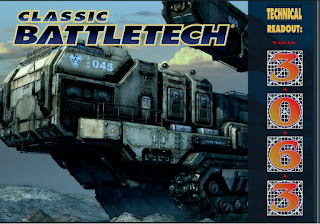
Technical Readout:3063 is an outstanding not-for-profit fanbook being put together by Steve Satak (Centurion13) and Bill Burt (Sounguru). Their goal was to create a set of vehicles which are not only compatible with the canonical universe (the book is meant to fill the seven year gap between TR:3060 and TR:3067) but also pull their weight better in-game than more "characterfully" flawed official designs do.
 | |
| The book doesn't skimp on art, either |
In June of '09 I helped revise the chapter introductions, for which Steve was kind enough to give me a writing credit. Now, I don't edit for a living and I don't know how my work compares to (say) editors at Penguin or McGraw-Hill, but I did try to hold the book to a professional standard. Steve appreciated this and so, from August of 2010 to October of 2011, I gave each TRO entry a good once-over.
This meant shuffling content around to get it under the correct headers, cutting redundant or vacuous text, slimming "Notable Crews" down to size, replacing slang and colloquialisms, fact checking, massaging the text for rhythm and flow, and finally returning it to Steve and his co-writer, Geoff, to insert new material as needed.
EDIT: We were using the "compare" and "merge" features of MS Word (Steve) and Open Office (me) to integrate changes, and it now looks like a good portion of my work did not actually carry forward into the final "merged" documents.
C'est la vie.
Since the book is nearing completion, I wanted to share some of my tools & resources:
How to Write Fluff
My old guide (I recall somebody, I believe Welshman or Paul, crediting Cray with supplying a similar outline to Catalyst's writers) and other notes from my 2007 review of TR:3025. That book averages 200 more words per entry than Steve's book does, so I'm pretty sure I reduced the following maximums (though not the minimums) by 25% before applying them to TR:3063.
59-227 overview
126-496 capabilities
109-571 battle history
17-252 variants
50-311 notable pilots (34-151 each pilot)
http://thesaurus.com/
My new favorite website. Ever get that single, perfect word stuck on the tip of your tongue? Nine times out of ten, this site helped me track from wrong (though related) words to the one I actually wanted.
http://isatlas.teamspam.net/
The Inner Sphere Atlas is probably the one site I used most (usually to check planetary history or to look for manufacturing leads).
The BattleTech Style Guide
Doesn't have everything you need to know for a TRO, but it's a solid start.
The Sarna BattleTech Wiki
Though generally accurate, their editors & contributors tend to parse things weirdly, so you should corroborate their assumptions/facts/conclusions against another source whenever possible. Luckily for me, most of TR:3063's references went back to the Field Manuals (which I have) instead of the FCCW SB or related novels (which I don't).
Longwalker's BattleTech Archive
I knew the online community maintained stat summaries (I've got a printout from 1990!) but this (fall 2004) was the first time I'd seen TRO fiction online too. The entries looked strangely slice & diced to me, but I saved html copies anyways, which I've been using to check on word usage and brand-name equipment. Longwalker's archive is now defunct, but someone at OBT has discovered it and other interesting sites inside the Internet Wayback Machine.
http://www.mechground.com/
In 2005 I found Mechground, which was more complete than Longwalker's site but displays each entry as an image instead of as searchable text. I have software (ACDsee) that allows a mouse wheel to page through image files, which I find more convenient than navigating inside a pdf, but my copies seem to be deteriorating (my Quickdraw is mostly unreadable now). I'll probably create my own replacements sooner or later.
Subscribe to:
Comments
(
Atom
)